 Support Number:


IT disruptions are expensive. They drain team productivity, aggressively slow operations, and cost real money. The impact of downtime is stark: small businesses lose an average of $427 per minute when IT systems fail, and larger ones can lose about $9,000 per minute.
Every downtime incident not only delays critical tasks but also directly impacts revenue and erodes customer trust. Simply waiting for issues to appear is no longer a viable business strategy. You need a proactive approach that keeps your systems running optimally and protects your business continuously.
Sandip Patel, Managing Partner, CISO, and President of Verdant TCS says, "Reactive IT support is a risk businesses can’t afford. Preventing issues before they start is the new standard for efficiency and stability."
The fundamental debate between break-fix vs. managed services matters now more than ever. Choosing the right support model directly affects your operational costs, downtime exposure, and long-term IT health.
This blog will clearly show you the differences, the pros and cons of each model, and the practical steps needed to make the switch without disruption.
Break Free from Break-fix Chaos Today!
Don’t gamble with costly outages. Move to a managed service model that prevents problems before they happen.
Learn MoreWhat Break-Fix Services Really Offer Today
Break-fix services are essentially pay-as-you-go IT solutions. Under this reactive model, you initiate contact with a provider only when a system failure or major issue occurs. The provider then arrives, resolves the issue, and bills you exclusively for the labor and any parts required.
The defining characteristic is the absence of any ongoing contracts, proactive monitoring, or long-term strategic support. You pay only for a fix, precisely when you need it.
This reactive approach appears to work for businesses with truly minimal IT requirements, as it keeps upfront costs low. You retain complete control over when and how outside support interacts with your systems. For very small offices or solo operations, break-fix services may seem adequate.
The service typically includes:
- Hardware Replacement: Repairs or upgrades broken physical devices to quickly restore immediate operations.
- Malware Removal: Provides quick fixes for severe malware infections or setting up a basic firewall to interrupt active security threats.
- Minor Setup: Simple, small-scale tasks like connecting a few network devices or installing basic application software.
However, this approach carries clear limitations. Break-fix services are purely reactive. They only address problems after they have appeared and caused disruption. There is no continuous monitoring to catch small, developing issues before they escalate. This means small incidents can quickly grow into major outages, leaving your business severely vulnerable to lost productivity, frustrated employees, and dissatisfied clients.
Choosing this model may save money initially, but the hidden costs of downtime and emergency, high-cost support can rapidly outweigh the perceived savings. These inherent weaknesses make proactive solutions far more appealing for any growing business.
How Managed Services Go Beyond Fixing Problems
Managed Services are defined as proactive IT solutions. Instead of waiting for problems to happen, your provider continuously monitors, maintains, and strategically manages your entire IT environment. This approach is designed to actively prevent downtime, significantly improve security posture, and directly align IT operations with overarching business goals.
Modern managed services incorporate a layered defense strategy:
- 24/7 Monitoring: Systems are continuously watched around the clock, allowing potential issues to be identified and resolved remotely before they can impact operations or slow down employees.
- Cybersecurity Defense: Provides continuous updates, proactive threat detection, and multi-layered defenses to effectively reduce the risk of targeted attacks and critical data loss.
- Reliable Backups: Files and system images are regularly backed up and rigorously tested for fast recovery, providing protection against hardware failures or accidental data deletions.
- SLA-Backed Support: Providers commit to guaranteed response times and specific service level assurances, ensuring prompt resolution for all critical issues.
Managed services also deliver predictable costs. You pay a flat, comprehensive monthly fee that covers ongoing monitoring, support, and strategic guidance. This model eliminates unexpected, high-cost bills from emergency calls and significantly reduces internal IT burdens. The financial benefits are proven: According to CompTIA, over 46% of companies utilizing managed services cut their IT costs due to fewer emergencies and minimized downtime.
Your managed services provider actively identifies opportunities for system improvement, recommends necessary updates, and optimizes internal processes. Unlike reactive break-fix services, managed services prioritize long-term stability and system resilience.
Cost Comparison: Break-Fix vs. Managed Services
At first glance, break-fix services appear cheaper because you only pay when issues occur. However, the true, compounding cost of downtime, emergency repairs, and lost productivity often drastically exceeds flat monthly managed services fees.
It is crucial to consider the full financial factors of the reactive model:
- High Downtime Costs: A single critical server crash can halt operations for hours. According to IBM, 33% of large enterprises lose a staggering $1-5 million to an hour of downtime. Break-fix services offer no preventative measures against this crippling expense, and the emergency response fees accumulate quickly.
- Unpredictable Expenses: Costs for labor, necessary replacement parts, and emergency after-hours service can lead to highly variable and often budget-breaking bills. This creates zero budget certainty.
- Lost Productivity: Employees cannot work efficiently while waiting for IT fixes or system restoration. This lost time adds up significantly over multiple, recurring incidents.
In sharp contrast, managed services offer definitive financial stability:
- Predictable Monthly Fees: Your IT budget becomes clear, fixed, and completely predictable, ensuring costs do not wildly fluctuate with every incident.
- Fewer Emergency Interventions: Proactive monitoring reliably detects and resolves minor issues automatically before they can escalate into expensive, critical problems.
- Reduced Internal Labor: Your internal team spends dramatically less time troubleshooting and more time focused on high-value business priorities.
For the majority of organizations, this shift results in substantial savings over time. A small business switching from break-fix can successfully avoid hundreds of hours of downtime and emergency costs, ultimately paying less annually while benefiting from higher system availability and performance.
| More articles you might like: |
Evaluating Risk Management in Break-Fix and Managed Services
Break-fix services inherently carry significant business risks. Their purely reactive nature, waiting until problems occur, leaves your organization severely exposed to extended downtime, complex security threats, and operational gaps.
The key risks of the reactive approach include:
- Extended Downtime Exposure: Critical systems remain offline until a technician can physically arrive. If a major problem occurs outside of standard business hours, the resulting delay can be extremely costly.
- No Business Continuity: Break-fix providers offer no planning for disaster recovery or data loss scenarios. If systems catastrophically fail, the recovery process is guaranteed to be slow, complex, and highly expensive.
- Critical Security Gaps: Without continuous, professional monitoring, malware infections, unauthorized intrusions, and vulnerabilities can go entirely undetected for extended periods, severely increasing the risk of a breach.
In comparison, managed services fundamentally minimize risk. Providers assume responsibility for continuous monitoring, prompt security updates, and regular backup integrity verification. This proactive intervention drastically reduces the chance of both downtime and irreparable data loss.
Successful managed services rollouts can push operational efficiency up by 45% to 65%. Investing in managed services effectively shifts the accountability for IT stability and security to your provider.
Their entire business model depends on keeping your systems functional and secure. This direct alignment ensures issues are addressed before they escalate, guaranteeing your business predictable uptime and a stronger, reinforced security posture.
Transitioning from Break-Fix Services to Managed Services
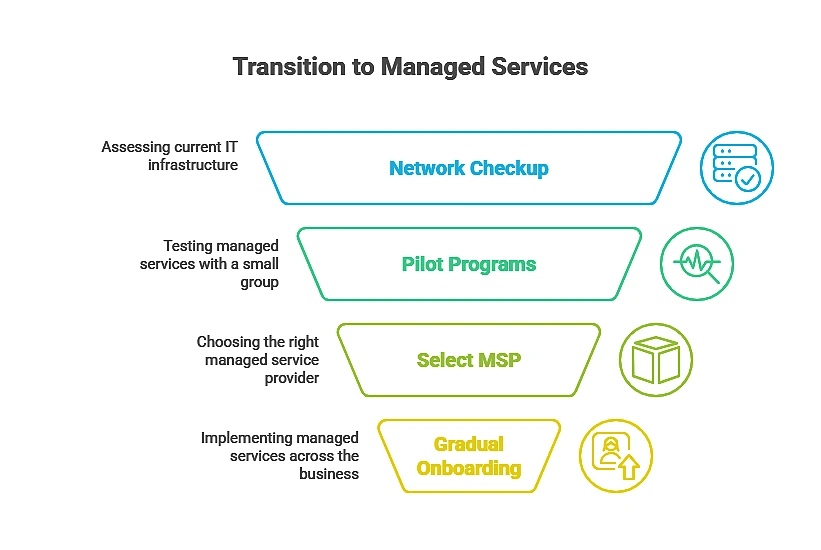
If your business currently relies on break-fix services, moving to a managed model is both highly feasible and strategically necessary. Businesses typically make this transition when recurring downtime, unpredictable costs, or weak security begins to visibly affect core operations and profitability.
The transition requires a few focused steps:
- Network Checkup: Engage a provider to comprehensively audit your existing IT systems to identify all hidden performance issues, vulnerabilities, and potential security gaps.
- Pilot Programs: Start by implementing a few managed services, such as cloud backups or helpdesk support. This allows you to test the provider’s capabilities and integration without immediately committing to a full overhaul.
- Select the Right MSP: Carefully evaluate potential providers for essential criteria: guaranteed 24/7 support, deep cybersecurity expertise, and relevant industry experience. Choose a partner with a clear, structured onboarding plan.
- Gradual Onboarding: Transfer your systems, monitoring, and support responsibilities to the MSP in well-defined stages to ensure zero disruption to your ongoing business operations.
Following these strategic steps guarantees a smooth transition from risky break-fix services to proactive, reliable support. The immediate result is stronger IT health, reduced emergency costs, and improved business resilience.
Break-Fix vs. Managed Services Feature Comparison
The following table highlights key operational areas often overlooked when comparing break-fix services to managed services. It clearly demonstrates what your business gains by adopting robust, proactive support.
| Feature | Break-fix Services | Managed Services |
|---|---|---|
| Cost | Pay-per-incident, highly unpredictable | Fixed monthly fee, completely predictable |
| System Monitoring | None—issue only reported upon failure | 24/7 proactive monitoring |
| Security Updates | Only performed when explicitly requested | Continuous patching and rapid threat detection |
| Backup & Recovery | Manual or only performed as-needed | Automated and regularly tested for integrity |
| Employee Training | Not included or offered | Included for security best practices and efficiency |
| SLA Response | No binding guarantees for service speed | Defined and documented service level commitments |
| Strategic Planning | None—purely tactical execution | Included to align IT solutions with long-term business goals |
| Downtime Risk | High due to reactive approach | Low due to continuous proactive measures |
Make the Switch from Break-fix to Managed Services with Verdant TCS
Choosing between the reactive break-Fix and managed services models defines your future IT costs, risk exposure, and overall business efficiency.
Break-fix services may briefly suit very small or minimally tech-dependent businesses, but they leave dangerous gaps in monitoring, security, and recovery planning. Managed services provide essential proactive monitoring, advanced cybersecurity, predictable costs, and strategic IT guidance.
Verdant TCS is a leader in providing managed services designed to protect revenue, reliably reduce downtime, and significantly improve operational efficiency. Our clients consistently report up to a 60% reduction in IT issues within 3 months of making the strategic switch to our comprehensive services.
| Trusted Managed IT Services Near You |
Contact us today to evaluate your current IT setup, secure your critical systems, and schedule a consultation. Protect your business effectively before the next unexpected downtime incident occurs.